Pages

Saturday, July 3, 2010

A trip west


Now don’t get me wrong… we love Kampala.  But after weeks of black exhaust fumes, countless piles of trash, loud nights, we needed a little break.  So after very little planning and a desperate need to see what else Uganda has to offer, we jumped in ‘Zuki (our semi-reliable Escudo) and headed west.  The four-hour drive to Fort Portal took us through the rolling Ugandan countryside with equal doses of roaming cows in the road and waving children chasing the car.  The drive proved to be far easier than anticipated thanks to huge investments in transportation from the Chinese resulting in new roads around the country.  We had beautiful views of huge tea plantations, fields of papyrus, and the beautiful Rwenzori mountains in the distance.
We decided to stay at the beautiful Ndali Lodge, which lies on the rim of an extinct volcano.  The lodge is owned by a British family who have owned the land for almost a hundred years.  Staying here was a bit of an indulgence but we thought we had earned it.  The lodge currently owns more than 1000 acres and produces many of their own fruit and vegetables, vanilla, and meat.  It was so nice to be served fresh local produce that didn’t consist of sweet potatoes, plantain or stewed chicken (don’t get me wrong, I do LOVE this stuff though).  The site itself was absolutely lovely.  There is very little better than having sun-downer cocktails overlooking a beautiful valley with huge mountains in the background.
The real reason to head out to Fort Portal wasn’t just for a relaxing weekend away.  What we really wanted to do was check out Kibale (pronounced chi-bal-eh) National Park.  The park is renowned for their chimpanzees.  It is estimated that there are about 750 chimps in the park, divided between several different communities.  The park is also filled with many other monkeys (different from other primates as they have tails), forest elephants, small antelopes, and many many birds. 
Upon entering the park, the roads were covered with baboons (it turns out that they are a bit of a pest here).  The first thing I noticed was that they are far less mangy in real life.  The distinctive calluses on the monkey’s bums were not nearly as large.  That being said, for some reason, baboons seem so unappealing.  Not soon after we arrived, we could hear the birds everywhere. 
We quickly picked up a guide (with a gun to ‘protect’ us from the forest elephants) and jumped back into the car and drove to the area of the forest where the chimps were last seen.  After only a five-minute walk, we could hear the chimps banging trees, calling to each other and playing around.  Within ten minutes, we had our first sittings of our nearest relatives.  These animals are truly astonishing in their human-like behaviour.  I know that this should not be a surprise but when you see them communicating, playing and running around, you really can see where we all came from.  It was a truly humbling experience.  We got to stay with the chimps for about an hour and a half, observing many different family members from the newborns to the grandfathers.  The young chimps are a bit freaky but older the chimps get, the more they look like humans.  Deb swears that the silverback (alpha-male) looks exactly like her dad (this is a complement John!!!).  
After our visit with the chimps, we thought we had earned ourselves a break so we headed back to the lodge to relax a little.  Besides, the England – Germany World Cup game was on that night and Paul and I still needed to locate a place to watch the game.  We got very lucky and the lovely owners of the lodge invited us to a BBQ at the ‘country club’ on the other side of Fort Portal.  Deb and Melissa decided to stick around the lodge for some spa time and cocktails.
The country club was not anything what we were expecting.  Instead, it was a bunker placed in a large field in the middle of a sprawling tea plantation.  The club was owned by a Irish expat and the ‘bar’ was filled with a variety of international football fans.  Unfortunately most were disappointed by the result.  However, the BBQ was to die for, with beautiful ribs and many trimmings.
The next day we went for a lovely little walk around one of the crater lakes with a local guide.  The lakes are actually the craters of volcanoes.  The walk therefore took us around the volcanoes rim.  Not remotely scary as the volcano is long extinct, but an interesting tidbit.  The walk was very nice and the guide showed off many local birds and talked about rural life in this part of Uganda.  

After a hearty lunch we were on our way back home, or so we thought….Our car decided that it did not want us to leave this beautiful area.  About 6 ks down the dirt road, the car decided it no longer wanted to work.  It quickly became clear that the alternator was not working and we would need some repairs.  We slowly got the car into a garage only to learn that we would need a new alternator.  As Deb, Paul and Melissa all had to get to work the next day, I was unanimously elected to stay the night in Fort Portal to wait for the car to be fixed.  As well that ends well and I was back on the road by noon the next day after the right parts where shipped up from Kampala overnight.
This trip reminded us where we are living and showed us how much we have to see around Uganda.  We can’t wait for the next adventure.

Saturday, June 26, 2010

Home sweet home

Deb here - yes, we admit it; we’ve been bad at updating the blog. Apologies. Here’s the first – all about getting our home set up here in Kampala – and we hope to add more updates soon ;)

wicker furniture
So, we live in a great two-bedroom apartment on Kololo Hill. It took a while, but we finally feel like we have really set-up our new home with furniture, curtains, plants – the whole lot. And we’ve recently acquired a roommate, Melissa, so we are having a blast.

Setting up a home in Kampala can be either really fun or really frustrating. It depends where you sit on the ‘design your own furniture, make your own curtains in Uganda’ scale of home decorating. We found it really fun, most of the time. Our couches and coffee table are stained wicker. We got them from a part of town called ‘Gabba Road’ which is essentially a road lined with stalls of people selling all matter of handmade furniture: wicker furniture, soft couches, beds, tables and chairs, etc. You just walk up and down the road trying to find what you like while trying not to look too interested. However walking up and down the road with Stu yields many people interested in us. Since Jesus was a carpenter, and most Ugandans think Stu is Jesus, we had many people wanting us to ‘bless’ their furniture. But we did go looking for furniture with my ‘Ugandan Father’, Haj, who is a private hire driver I was introduced to through a colleague. Haj takes me around town at night and in the rain and is a very sweet ‘father’. He always makes sure that he is dropping me somewhere safe and that Stu or a friend is waiting at my destination, otherwise he waits with me. When I told him we were looking for furniture, he insisted on taking us to make sure we got good quality at a good price. Which we did – and we had a blast together. Just picture me, Stu and a 60 year old Ugandan man walking amongst hundreds of half made couches deciding on which is the most stylish and would suit our apartment the best and which fabric is most durable and easiest to wash. It was kind of like the three stooges! We purchased a coffee table, a two-seater, and two one-seater brown stained wicker couches with an ‘african print’ fabric.


Then we headed to ‘Port Bell Road’, another area of town to get our bed set and kitchen table. Port Bell has a row of carpenters who can make just about anything you want. They are quite good a reproducing items from a picture. It was very funny when we said we were looking for a bed and the carpenter pulled out an Ikea catalogue!! We decided on a sleigh-bed type design with two bed-side tables. I also designed a dressing table, stool and mirror combo. Our kitchen table and chairs are also quite beautiful in dark chocolate brown. The last piece of furniture we’ve had made is a high buffet table (?). I actually have no idea what it’s called, it just a narrow 18 inches x 4 feet table that is bar height, I think. Either way, it looks great against the wall!

At my 'dressing table'


The final touches to our apartment were to get some curtains made. It’s very expensive to get ‘real’ curtains made from the furniture/fabric store (and they are quite heavy and outdated), so we decided to go on our own curtain making adventure. We found out that the beautiful African fabrics can be found at Kyembe (chi-em-bay) Market. So Stu and I headed off with our window measurements. Kyembe Market is like a hardware store meets electronics store topped off with a fabric store. Except I use the word ‘store’ lightly; it’s actually a mesh of streets and alleys with stalls crammed into every space. Some stalls sell all manner of hardwares for building or fixing; others speakers, car radios and televisions; and others fabrics and sewing machines. We walked around, trying not to stick out, as not many ‘muzungos’ (white people) shop in this market.


We ended up at a tiny shop about 10 feet by 6 feet stacked floor to ceiling with the most colourful and beautiful fabrics. We were greeted warmly by Sakira and the 8 other women in the shop who were busy sewing on their old Singers. I was in heaven. First, we had to pick the fabric, which is actually quite hard and I, of course, was being picky with the colours. Shakira pulled one fabric after the other off the shelves and we had a fun go at, “no too green, no too brown, too printed, not enough print”, etc, etc. We finally settled on a fabric for the bedroom, only to find Shakira did not have enough of it, so she sent someone on a run through the market to find more. In the meantime, I had to explain to Winnie the tailor/dressmaker (who’s mother coincidentally is named Deborah, so we were instant friends) that I wanted curtains with loops. “Loops? Why loops, what about hooks?” was Winnie’s reply, and we had a debate on the aesthetics of loops versus other forms of curtain hangings. In the end, my loops won out. Then we had to give the measurements. We measured our windows in centimetres but Winnie works in inches, so Stu started on a lesson of converting cms to inches. Then we had to figure out how much fabric we needed and how best to use the 6 yard bolts to make curtains approximately 2-3 times the length of our windows (standard curtain making procedure...Mom knows what I mean!). I was utterly confused and there was Stu, knee deep in fabric, arms outstretched, going on about “lengthwise, rotate, sew, cut”... I wanted my curtains to look great; Stu wanted to get the most curtain out of the least amount of fabric. My attempts to match the pattern between the two curtain panels was thwarted by Stu’s desire to squeeze 18 feet of curtain from 18 feet of fabric not taking into account seams, hems or...the loops! Geesh... Just picture the two of us and 8 Ugandan women stuffed into a tiny colourful space going around and around in circles of centimetres, seams and loops. We attracted an audience. In the end, we settled on something, but I wasn’t quite sure what.

Winnie, Deb and Shakira in the fabric shop at Kyembe Market

Our balcony and plants as the sun is setting
I went back to pick up the curtains a few days later, and they were absolutely great! Shakira and Winnie are now our go to gals for anything tailoring and I’ve taken my roommate there for curtains. We have a blast with them and have plans to make many more things for the house.

So there you have it. Home sweet home. Now you just need to come visit so you can see our furniture and curtains in person!

Kisses from Kampala,
D and S

Monday, May 17, 2010

The Mighty Nile...home at last!

So it has been a while since our last post. We have had a pretty exciting last couple of weeks. Life here is becoming more routine. We have finally fitted our house out with (most of) our furniture and we should have a car by the end of the week. In typical Deb and Stu fashion, we have already played host to friends from around the world. The bed and breakfast is officially open!

Kampala lies about five kilometres from Lake Victoria, which would seem like a dream for water-minded folk like us. However, despite being taunted daily with view of the lake from our apartment, we cannot swim in the lake because of Schistosomiasis. This little parasite caused by water snails has meant no swimming for fear of getting ill.

This weekend we may have found the solution to all of our woes. About one hour from Kampala is a small town called Jinja that has tried to become an outdoor hotspot in Africa. It is host to the equally important source of the legendary Nile (although this is still academically disputed by some geographers) and the largest brewery in Uganda, the Nile Brewery (as a side note, Uganda has a depressingly high level of alcohol consumption. Some studies have put alcohol consumption per capita in Uganda as the third highest in the world) Jinja has recently had a huge zipline and bungee jump installed. However, we went to experience some of the biggest white-water
in the world. The mighty Nile has some amazing class 5 rapids that are easy to access and provide HUGE water.

We have rafted in some pretty big water before but it was nothing like this. The Nile is a great place to raft because the water is warm (around 25), there are few rocks and the scenery is amazing. A great Ugandan named Henry guided us down the river. He has been paddling this stretch of the Nile for almost ten years and seems to know the water inside and out. As we started, he asked us how we liked it "mild or wild". We opted for the wild and boy did we get it. We started off with some small class 1 and 2 water involving a lot of swimming and enjoying the lazy-river styles. It was great to just lie back and float. There were many birds and flowers along the bank to enjoy as we meandered closer to the big water. We could hear the rapids before we could see them. As we approached the first section with bigger
water, the guide remarked that we sure like to be in the water. The next
thing we knew, we were upside down in an infuriated patch of the Nile River, a ceiling of white water above us, all those tranquil birds and flowers along the banks a violently disappeared memory. We emerged with huge smiles and joy of the water we had been looking for.

And that was just Round one. During the trip our raft flipped several times. We went flying off waterfalls. We got twisted around rocks. The whole experience was like riding a bouncy castle through a tsunami. In some places, the water seemed to defy the laws of physics, with giant, green frothy waves crashing into one another at impossible angles. The guides were careful about the crocs - which, yes, do bite, and in the few known crocodile hang-out spots, we weren't allowed in the water.
Every once in a while we'd pass fishermen paddling along in log canoes.

As we approached the last set of rapids (aptly named 'bad place') we were sad to be ending the day. It had been such a blast paddling around with friends and enjoying the outdoors. It was such a break from the chaos of Kampala. Before we entered the last set of rapids, our guide instructed us that if we fell out of the boat on this run, don't hold on to the boat; just let go or it could get hairy. As we entered the last set, the raft smacked into a torrent of white water, and in milliseconds, our bouncy castle was swamped. The river was actually swirling inside the raft, trying to yank us out. We clenched the safety rope along the edge with all our strength. Our hearts were pounding. Our grips were slipping. And then, poof! It was over, and we were floating through flat water again minus to of our friends who
had panicked and followed the guide's instructions not to hold onto the boat should we flip. They were calmly returned to the boat by rescue kayakers and we spent the rest of the evening rejoicing in our adventure, enjoying some beers while overlooking the river.

When we left on Sunday afternoon, one thing was for sure - we would be back. We had decided to join a kayak course on the Nile and hope that before long we will be bouncing through the rapids on our own and enjoying the beauty and power of the great Nile. Who could think of a better way to enjoy our weekends?

Tuesday, May 4, 2010

The Royal 'We'

I thought it might be worth explaining that in the previous post, the 'we' Stu refers to is not 'we' as in Deb and Stu, but rather 'we' as in Stu and Paul (Stu's friend from MA days in Brighton). I (Deb) was at work on Saturday when Stu was off exploring. And I was working on Sunday as well. Oh and I was also working 14+ hour days Monday to Friday! Needless to say, it's been a hectic few weeks with work. 'We' as in my team at work, have many deadlines to hit by June so we are working around the clock. The good thing is that today I submitted abstracts to the American Society of Tropical Medicine and Hygiene, so maybe I'll get accepted to the conference in November. Actually, I don't think this will happen, but I'm excited to have submitted some work based on my MSc thesis (finally!). So, apologies for not emailing or calling, but, 'we' are doing great! Miss you!

Monday, May 3, 2010

May Day


Last weekend was May Day in Uganda (I don’t know why we don’t celebrate in Canada).  We were planning on going to Jinja (about an hour away) to do some paddling and whitewater rafting.  The Nile starts at Lake Victoria and actually has a couple runs of class 5 rapids and even a couple of class sixe rapids.  As it turns out, things got really busy at the end of the week so we ended up staying around Kampala.
We decided to hit up this place called the BBQ lounge.  One of the things that has really surprised us in Uganda has been the variety and quality of food.  Before we arrived, everyone told us to be sure to get our fill (and we definitely did!) of good meet.  We were anticipating a lot of beans and goat.  Although Uganda does love their beans and goat, there is also plenty of other meats.  In fact, it seems as though the favourite Kampalan meal is BBQ pork.  I can’t say we are complaining.  It is pretty great to get pork on a stick wherever you turn.  BBQ lounge provided all kinds of other meats as well and reminded us of the Argentinean parrillada we loved so much in Buenos Aires.  The meat is cooked to order on a charcoal BBQ and we eat outdoors in 25 degree weather.  Not too much to complain about.
On Saturday, Stu headed to Lake Victoria and checked out Gaba and Munyoyo, two traditional fishing ports.  It is amazing to see how much the introduction of the Nile perch has impacted on the local fishing industry (check out Wikipedia if you need more details).  These areas are known as the places where Kampala picks up the fish from the local fisherman.  However, there seemed to be very few fishermen and no infrastructure to support fish export.  Instead, each town had a small market with stalls selling the cooked fish.  It is hard to believe that much of the catch gets to Kampala any more.  We couldn’t leave without trying the local foods.  This part of Lake Victoria fries the tilapia whole.  I wasn’t really sure if I would like the whole fish, especially deep-fried, but it was delicious.  It is amazing how good fish tastes when it is so fresh.  We definitely need to try to get more of the fresh fish into our diet.
While dinning lakeside on our fresh fish two birds that represent the polar opposites of the ornithological spectrum joined us.  The pleasant and very beautiful Ugandan crested crane (above), the Ugandan national bird, and the grotesque Marabou Stork (below).  Uganda has an amazing variety of birds with over 1000 species.  Even in urban areas, it is possible to see a wide variety of ducks, herons, hawks, eagles, kingfishers, magpies, and all sorts of birds I have never seen before.  However, around Kampala it is the stork that is king.  They scavenge all over the place.  The locals call them pterodactyls as they are frequently gliding in packs over the city.  They can grow up to five feet tall and have a wingspan of over 10 feet.  They are truly terrifying beasts.  What makes them even worse is that they are some of the ugliest things.  Their heads look like they have been in a fire, their head and neck is covered with grey hair that looks like they are balding, they have a pink neck ruff that looks like a brain, and their gular sack grows as it eats.
 It is nice to see some local fauna but we can’t wait to see some of the big game Africa is famous for.

Tuesday, April 27, 2010

Furniture has arrived (sort of)

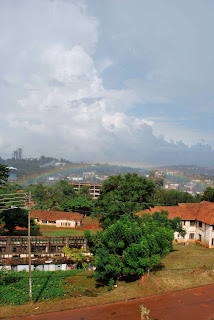
Just a quick update today. This has been a great week so far. Yesterday we had a crazy rain storm which somehow turned into sunshowers. There was a rainbow which seemed as though it could not have been more than 150 yards from out apartment (see picture). Then today, some furniture came. We have been asked to post some pictures of our place. As we still lack a table, and everything in the bedroom, I have posted the view of our balcony (with the rainbow), our backyard, and the living room. More to follow. Not to worry.


Thursday, April 22, 2010

Our home

So we have moved into an apartment. We were staying in a serviced apartment since we arrived that was set up by Deb’s work. While we enjoyed the place, it just wasn’t ‘home’ for us. We looked at many different places ranging from large houses in private compounds, gated townhouse communities (yuck!!) to apartment buildings. In the end, we have settled on a two bedroom (just waiting for you to come to visit!!) apartment with lovely outdoor space. Kampala is made up of seven hills and we are close to the top of one of them. We have great views over the city and get lots of green. We have large enough balconies that we are going to try to grow some of our own fruit, veg and herbs. As long as Deb keeps her thumbs of death away from our garden, we will hopefully be eating our own stuff soon enough. Perhaps the best part of the apartment is that we share a pool!! Deb has already spent a lazy Sunday afternoon ‘working’ by the pool.

We have now been in our place for almost two weeks although it is still difficult to call it ‘home’. We rented the place ‘unfurnished’ and they were not joking about how bare it was. We had nothing in the place. No cooker, no fridge, no blinds, no curtains, and definitely not any furniture. Luckily we borrowed a mattress and have had something soft to sleep on (although we had no pillows for the first 5 nights). We thought it would be easy to find some used appliances and get sorted quickly. Although there are stores here that cater to expats and have the things we needed, most were not good quality and we were always charge way more than locals. Stu has done what he does best and chatted up all the locals to find the best spots for all of our specific needs. It has taken some time but things are coming together. We can now make our own food, keep our beer cold and have chairs to sit on the balcony. Even though it sounds like it has been rough, it has been a really pleasurable experience getting here. We have gotten to choose the things we want rather than what the stores think expats should want and have been to many areas where expats don’t normally venture. Along the way we have been able to enjoy what might be a bit more of an authentic experience.

I (Stu) have been doing most of the shopping and the local motorcyle taxi (bodas) have grown fond of taking me for a ride, talking football (soccer), local events, or whatever else, and then being laughed at as we proceed home loaded up with crates of beer, pop, groceries, tables, chairs, 18L water jugs, or whatever else I have picked up that day. Ugandans are not shy of laughing or enjoying a situation and when they see Jesus (as I am known here to most folk) riding the boda just like they do, they really do love it.

I have had several other brilliant experiences where the locals could not believe I would venture into ‘their’ land. Perhaps the most memorable is from my meeting with the Local Chief of our neighbourhood. Although Kampala is urbanised (there are 1.5 million residents) it is still possible to see the history of what the city and the agriculture was like 100 years ago. There are banana trees growing on our street and chickens and goats are in abundance. The area is also still ruled by the Bugandan king who has a rocky relationship with the central government (perhaps we can post more on this once we understand it better. The simple root of it is that there is a very large following of the monarchy and the government is seen as an outsider who has taken their land). Part of the arrangement with the kingdom is that there will be local representation down to the smallest areas. I needed to meet with the Chief to get a ‘reference’ for the bank. The reality is that it is a small piece of bureaucracy that brought me such pleasure. I was in interviewed for almost an hour about my past experiences, views on Uganda, what Deb was doing here, etc.

So I passed the interview and was told to wait outside with some locals. We got to chatting and for some reason (this seems to frequently happen to me) we started talking about local food and drink. The group were impressed that I enjoyed matoke but disappointed that I had yet to start with my family of chickens. They did promise to help me out once I was ready and would take me to the market to make sure I got a fertile hen and rooster (to keep your chickens going, you need to make sure to leave a couple of chicks to grow up and take the place of your hen once you eat her). I was also was ‘taught’ about several of the different alcohols that Uganda is known for. They make several very interesting alcohols out of banana and a very sweet one out of millet, which you drink from straws out of a communal pot.

After 45 minutes the chief returned with my hand-written reference letter describing me as “law abiding”, “cooperative to his neighbours” and “congenial”. I wasn’t sure he had the right person when I read the letter. Either way, I have made some friends and have popped down several times for a catch up since.

One thing is becoming clear. Although our physical space may not feel like home yet, Kampala is. Our neighbours and those around us are making us feel like we have been here for ages.